



ILLUMINATED MANUSCRIPT LEAF: CIRCLE OF THE MASTER OF COËTIVY (COLIN D’AMIENS)
"The Angel Gabriel was sent unto Mary the virgin"
A RICHLY ILLUMINATED 15TH-CENTURY LEAF FROM A PARISIAN BOOK OF HOURS. FROM THE CIRCLE OF THE COËTIVY MASTER, FEATURING INHABITED INITIALS, LAVISH GOLD-HEIGHTENED BORDERS, AND RARE MARGINAL ROUNDELS NARRATING THE LIFE OF SAINT ALEXIUS.
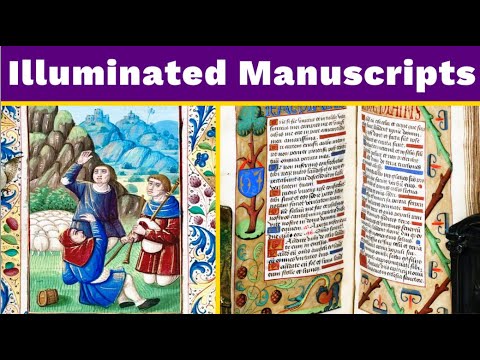
This beautifully preserved manuscript leaf, painted within the circle of the Coëtivy Master—one of the most accomplished artists of the French court—features captivating marginal roundels and lavish decorative borders.
The page is ruled in red for a column of thirteen lines and written in elegant Gothic book hand in dark brown ink, with rubrics in lustrous burnished gold. The text begins with an inhabited initial illustrating a pink-and-white winged creature against gold; the designs framed by a gold and pink bar border that runs along three sides of the column. Both recto and verso are enriched with elaborate full borders of acanthus, flowers, delicate vinestem ornament, varied foliage, and gold bezants. In the lower margins stand two oak trees, each with eight acorns, flanking a pair of circular depictions regarding the life of Saint Alexius. There is minor chipping to the faces in these drawings and faint traces of old mounting tape at the inner edge. The colors remain vivid, the gold bright. Matted and framed under glass in a gold frame with cream matting.
The leaf likely originated in the Alexis Hours, a Parisian commission for a wealthy patron whose devotions centered on Saint Catherine of Alexandria and the rarer Saint Alexius. The parent manuscript included an extensive series of marginal illustrations narrating episodes from both saints’ lives, suggesting the story carried personal meaning. On this leaf, the first illustration depicts a crowned ruler receiving a kneeling figure with a spear; the second shows that same individual departing. These scenes likely refer to Saint Alexius’s departure from home at the beginning of his renunciation: according to medieval legend, Alexius left a life of privilege to live as an ascetic in Edessa for seventeen years, before returning to Rome unrecognized, dwelling in obscurity until his death and posthumous recognition.
Latin reads:
[Back] Missus est angelus Gabriel ad Mariam virginem desponsatam Joseph nuntians ei verbum et expavescit virgo de lumine ne timeas Maria invenisti gratiam apud dominum ecce concipies et paries et vocabitur altissimi filiu.
[Front] Sancta Dei Genitrix, quae digne meruisti concipere quem totus orbis nequivit comprehendere, tuo pio interventu culpas nostras ablue: ut perennis sedem gloriae per te redempti
valeamus scandere, ubi manes cum Filio tuo sine tempore.
In English:
The Angel Gabriel was sent unto Mary the virgin espoused unto Joseph, shewing unto her the word: and the virgin is amazed at the light: fear not Mary, thou hast found grace with our Lord: Behold thou shalt conceive, and bring forth, and he shall be called the son of the most high.
Holy Mother of God, who worthily merited to conceive Him whom the whole world could not contain, by your loving intercession wash away our sins, so that, redeemed through you, we may be able to ascend to the seat of everlasting glory, where you remain with your Son beyond time.
Its elegant figure style, expressive faces, and refined ornament firmly place the work within the circle of the Coëtivy Master (Colin d’Amiens), among the foremost illuminators active in Paris during the third quarter of the fifteenth century. The workshop is recognized for its distinctive border designs, angular yet graceful facial types, and the innovative use of marginal roundels to weave narrative scenes into the page—an approach that exemplifies the sophistication of late medieval Parisian manuscript illumination.
195 × 145 mm; dimensions including framing: 420 × 345 mm
Provenance:
Almost certainly commissioned by an aristocratic or noble patron—possibly a couple devoted to Saints Catherine and Alexius. The oak trees, each with eight acorns, may hold heraldic significance. The parent manuscript (MS 246) appears to have been dismantled in the early 1980s, with many calendar and text leaves appearing on the market by the mid-1980s, landing in a private collection, before sale in Hindman Auctions.
Reference
- Avril, François. “Autour du Maître de Coëtivy: Quelques manuscrits parisiens des années 1450.” Art de l'enluminure 14 (2005): 2–31.
-Avril, François, and Nicole Reynaud. Les Manuscrits à peintures en France 1440–1520. Paris: Bibliothèque nationale de France, 1993.
- Fliegel, Stephen N. The Jeanne Miles Blackburn Collection of Medieval Manuscripts. Cleveland: Cleveland Museum of Art, 1991, no. 49.
- Netzer, Nancy, ed. Secular/Sacred, 11th–16th Century: Works from the Boston Public Library and the Museum of Fine Arts Houston. Boston: McMullen Museum of Art, 2006, no. 67.
- Nordenfalk, Carl. “Les manuscrits enluminés de Coëtivy et la peinture parisienne autour de 1450.” Cahiers de civilisation médiévale 6 (1963): 241–48.
- Porcher, Jean. “Le Maître de Coëtivy et la peinture parisienne vers 1450.” Bibliothèque de l’École des Chartes 117 (1959): 61–90.
- Research for the Hindman catalogue entry by Sandra Hindman and Peter Bovenmyer.
Price: $4,200 .