


Distant Electric Vision
"This part of the problem of obtaining distant electric vision can probably be solved by the employment of two beams of kathode rays (one at the transmitting and one at the receiving station) synchronously deflected by the varying fields of two electromagnets placed at right angles to one another and energised by two alternating electric currents of widely different frequencies, so that the moving extremities of the two beams are caused to sweep simultaneously over the whole of the required surface within the one-tenth of a second necessary to take advantage of visual persistence." -A. A. Campbell Swinton
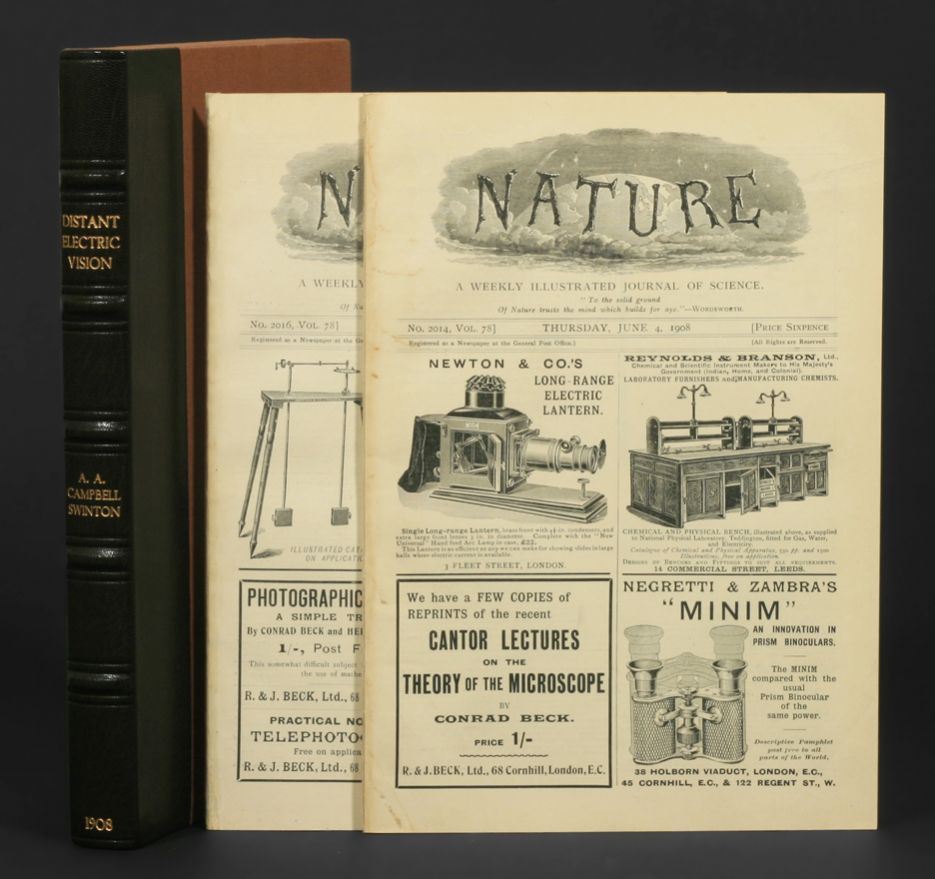
FIRST PRINTING IN ORIGINAL WRAPPERS of the earliest description of television; generally considered the most important paper in the development of television.
Responding to an article in the June 4, 1908 issue of Nature by Shelford Bidwell entitled "Telegraphic Photography and Electric Vision," [also included here in original wrappers] A. A. Campbell Swinton wrote a letter to the editor of Nature proposing a solution to the most pressing problems in achieving "distant electric vision":
"The final, insurmountable problems with any form of mechanical scanning were the limited number of scans per second, which produced a flickering image, and the relatively large size of each hole in the disk, which resulted in poor resolution. In 1908 a Scottish electrical engineer, A. A. Campbell Swinton, wrote that the problems 'can probably be solved by the employment of two beams of kathode rays' instead of spinning disks. Cathode rays are beams of electrons generated in a vacuum tube. Steered by magnetic fields or electric fields, Swinton argued, they could 'paint' a fleeting picture on the glass screen of a tube coated on the inside with a phosphorescent material. Because the rays move at nearly the speed of light, they would avoid the flicker problem, and their tiny size would allow excellent resolution. Swinton never built a set (for, as he said, the possible financial reward would not be enough to make it worthwhile)..." (Britannica).
Swinton presciently concluded his letter with the hopeful statement that with his technique "distant electric vision will, I think, come within the region of possibility." Cathode rays would, of course, be used to great success in the development of television and Swinton's recognition of their possibilities is often cited as the critical discovery that made television possible.
In: Nature, vol. 78, no. 2016, p.151. June 18, 1908. WITH: BIDWELL, Shelford. Telegraphic Photography and Electric Vision. In Nature, vol. 78, no. 2014, pp. 105-6. June 4, 1908. London: The Macmillan Company, 1908. Octavo, original wrappers rebacked. Housed in custom half-morocco box. Fine copies. Extremely scarce in original wrappers.
Check Availability:
P: 212.326.8907
E: info@manhattanrarebooks.com